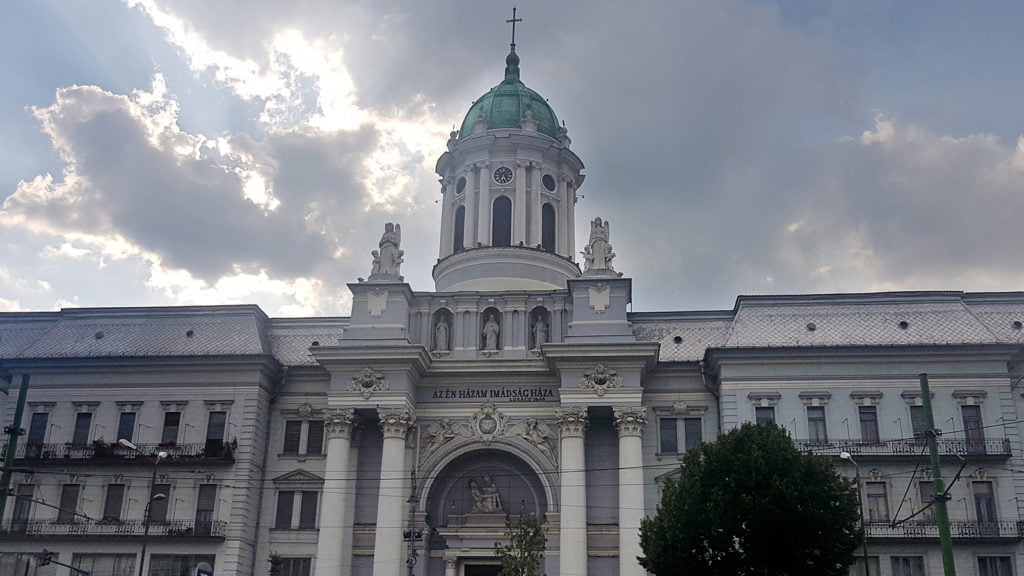
Although it is considered a transit city, Arad has often been compared to several major European cities, even earning the nickname “Little Vienna.” Why? Because most of the buildings you find on the streets of Arad are grand and imposing — there are over 100 buildings from the 19th and 20th centuries included in Romania’s National Cultural Heritage.
Similar to Vienna, I found the city to be very organized and orderly, with a wide main boulevard. The buildings lining both sides of this boulevard display a variety of architectural styles, including Baroque, Neobaroque, Eclectic, and Neogothic.

Although it’s not a very large city, it serves as the main western gateway into Romania and is an important connection hub to the rest of Europe. From Arad, it’s very easy to reach Budapest, Bratislava, Vienna, and many other cities (which I highly recommend if you’re in the area — trains are very affordable, and traveling by car is even easier).
And even if you’re not planning to visit another city, I believe Arad itself is well worth exploring in full.
So, let’s take a look at some of the tourist attractions in Arad that are definitely worth a visit:
1. Starting from the Continental Forum Arad Hotel, where I stayed (you can also try their daytime bar — they serve excellent coffee and delicious cakes), I headed toward the first attraction: St. Anthony of Padua Church. Built at the beginning of the 20th century, this church stands out for its absolutely magnificent architectural details. Both the exterior and interior feature Renaissance-style elements that make the church a true work of art.
Even more impressive is the exceptional replica of a Michelangelo piece, crafted in white marble, placed above the entrance.
It’s definitely one of the 8 must-see tourist attractions in Arad that you shouldn’t miss if you’re visiting the city.
2. The “Ioan Slavici” Classical Theatre is a building constructed in the late 19th century in a neoclassical style, spread over three levels. The first performance held in this theatre took place in 1874. It’s an imposing building that really stands out, located at the end of Arad’s main boulevard, Revoluției Boulevard.
I didn’t get the chance to attend a play, but various artistic performances are held here every day of the week (except Mondays). You can find more details here.
3. Avram Iancu Square is one of the most important squares in the city of Arad. It’s surrounded by buildings featuring Baroque, Secessionist, and Neoclassical architecture, such as the Domany House, Nádasdy Palace, and the Pharmacists’ Palace. In the center of the square stands the “Unknown Soldier Monument”, adding to the historical significance of the area. This square holds special importance because it was once the location of Arad’s old City Hall, which has since been relocated.
Around the square, you’ll also find several buildings with interesting facades, and at their base, a variety of clothing stores and supermarkets.
4. The Cultural Palace is an architectural gem that currently houses the County Museum and the State Philharmonic.
The building combines a wide range of architectural styles, including Neoclassical, Corinthian (seen in the front columns), Italian Renaissance, Art Nouveau, and Gothic.
The museum complex inside the Cultural Palace features an impressive collection dedicated to natural sciences, the Romanian Revolution, and the history of the city.
Whether or not you’re passionate about history or art, I highly recommend a visit — especially since the ticket price is very affordable (2 lei for adults, 1 leu for students).

5. The Administrative Palace (City Hall) is one of the city’s most important buildings, featuring Renaissance-style architecture and built at the end of the 19th century.
It has a 54-meter-high tower and a clock purchased from Switzerland, whose mechanism plays “Ode to Joy” on the hour. The palace is grand and impressive, dominating the entire boulevard with its presence. It can also be visited inside, but only during the working hours of the institutions based there — and generally only with a guide and as part of a scheduled group.
6. The Cenad, Neumann, and Szantay Palaces are three buildings located in the city center, around the City Hall Palace.
These are three impressive buildings that you can’t miss due to their grand presence and spectacular architecture. The Cenad Palace is built in an eclectic and neoclassical style and is easily recognizable by the statue of the god Mercury on its pediment. The Neumann and Szantay Palaces were constructed in the eclectic style and the Viennese Secession style, with the latter being one of the most representative buildings of this style. Currently, these three palaces house various commercial spaces and residential units.
7. The Red Church is an impressive church that rises among trees and residential buildings on the city’s main boulevard, Revoluției Boulevard.
It serves the Hungarian congregation of the Evangelical Lutheran Church, and its name obviously comes from the fact that its exterior walls are made of polished red bricks.
The church is built in the Neo-Gothic style and is open for visits, which I highly recommend because the interior is just as impressive.
8. The Arad Fortress is a fortress built on a bend of the Mureș River at the end of the 18th century.
The fortress has a six-pointed star shape and was one of the largest military prisons in the Habsburg Empire. It held important historical figures such as Horea, Cloșca, and Crișan, as well as French prisoners from Napoleon’s army. Unfortunately, the fortress can only be visited during Arad Days, when its gates open once a year for visitors.
The city of Arad boasts a rich cultural and historical heritage, serving as an open-air museum for those who choose to visit it. The architectural styles specific to the 19th and 20th centuries, along with its art monuments, have earned the city the nickname “Little Vienna.”
In addition to the 8 tourist attractions in Arad mentioned earlier, visitors can also discover the city’s more hidden corners, such as the “Lunca Mureșului” Natural Park, Reconciliation Park, and the Water Tower. I recommend the city because I believe Arad offers an activity for every type of tourist: architecture lovers can admire buildings constructed in Baroque, Renaissance, Gothic, and many other styles; art and history enthusiasts can visit the Museum Complex of Arad Municipality; and those who appreciate good taste and gourmet food can visit the Continental Forum Arad Hotel, where they will find hospitality and comfort, as well as carefully selected delicious dishes.